
By Vicki Larsen, NP
If you’re considering freezing your eggs, you may have already started looking into fertility testing. And once you have your results, it’s natural to have questions. Is my AMH level good? What does my egg count mean? Do these numbers tell me whether egg freezing is right for me?
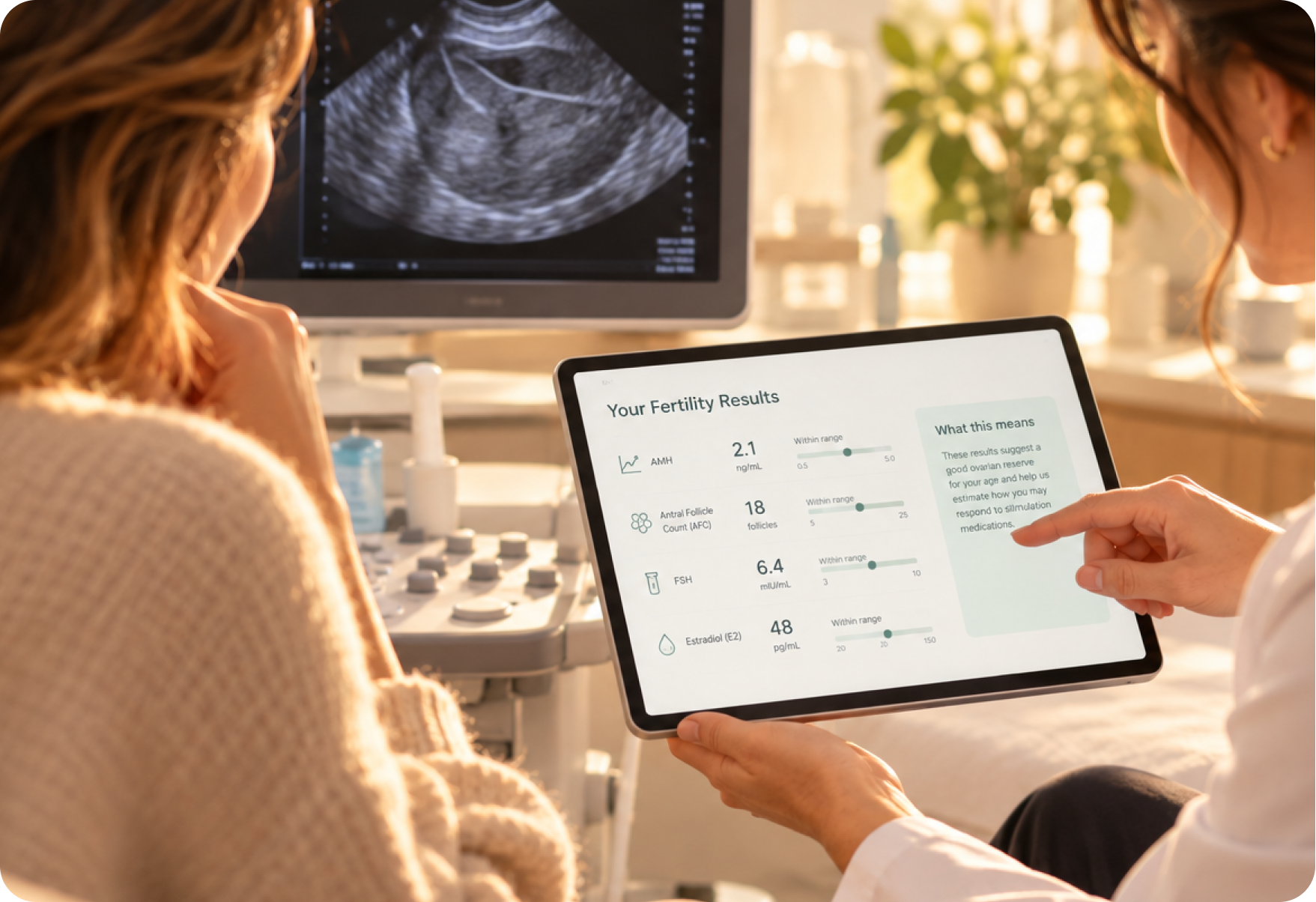
The truth is, fertility testing isn’t quite that simple. Your AMH (anti-müllerian hormone), AFC (antral follicle count) and other results aren’t a grade or a verdict, and no single number tells the whole story. Instead, they offer valuable insight into your ovarian reserve and help you and your care team understand what egg freezing might look like for you.
Understanding these numbers is an important first step, but it’s just one piece of the bigger picture. Let’s break down what your results actually mean, what they don’t, and how they can help you make informed decisions about your fertility and future options.
Why can two women of the same age have completely different outcomes?
Two people who are the exact same age can walk into an egg-freezing cycle and come out with very different results. Genetics play a role, environment likely plays a role, and figuring out exactly how much each factor contributes is an active area of research.
What we can do is get a good read on where you stand using two main tools:
AMH (Anti-Müllerian Hormone)
This blood test gives us an idea of your ovarian reserve, basically, a gas gauge for how many eggs you have left. It’s a helpful number, but it’s not the whole story: AMH tells us more about egg quantity than egg quality. A lower AMH doesn’t automatically mean you can’t get pregnant, and a higher AMH doesn’t guarantee that your eggs are all high quality.
AFC (Antral follicle count)
This comes from a transvaginal ultrasound, where we count the small follicles, think of them as baby eggs, resting on the surface of your ovaries that cycle. This number naturally fluctuates month to month, but together with AMH and your other hormone levels, it helps us estimate how you’re likely to respond to stimulation medication.
The main takeaway: age gives us useful information about what to expect at a population level, but ovarian reserve testing helps us understand your individual quantity and expected response. Two 37-year-olds can have very different ovarian reserves, which is exactly why testing matters so much.
What does fertility testing actually involve?
The process itself is simple. A fertility evaluation typically includes:
- Bloodwork
- A transvaginal ultrasound
- An antral follicle count
- A review of your ovarian reserve and hormone levels
- A follow-up conversation to put it all together
We typically schedule testing around cycle days 2 through 5, but if your cycle is irregular, we can still do a baseline evaluation without waiting around for a specific day.
The testing appointment itself takes about 20 minutes. A couple of weeks later, we’ll get on a call, usually about 30 minutes, to go over your results, talk through recommendations, and answer any questions.
You don’t have to have already decided you’re freezing your eggs to get tested. Testing is simply a way to understand where you stand today, and what your options might look like from there. The Onto Clarity Program is a simple first step designed for anyone who is curious about their fertility or considering egg freezing and wants more information before deciding what comes next.
Should you freeze eggs or embryos?
This is a conversation we have often with patients over 35, and it’s worth understanding both paths.
Egg freezing:
- Doesn’t require a sperm source
- Preserves more flexibility and autonomy
- Lets you decide later, whether, when, and with whom, to create embryos
Embryo freezing:
- Requires fertilizing the eggs with sperm now
- Gives you more information up front, since fertilization and early development have already happened
- Allows embryos to be genetically tested (PGT-A) before future transfer, if you choose
For context, egg thaw survival rates run around 80% to 90%, while embryo rates tend to run a bit higher, around 95% to 98%.
One option isn’t universally “better”. It depends on your relationship status, your family-building plans, how you feel about committing to a particular sperm source right now, and simply what feels right to you.
What is an egg-freezing cycle actually like?
Patients often imagine this process will take over their lives for months, but it doesn’t.
The active part of treatment is usually about 10-14 days of medication, followed by the retrieval itself. Broadly, it looks like this:
- Baseline testing
- Daily stimulation medications
- Monitoring appointments to track your progress
- A trigger injection
- Quick egg retrieval procedure
- Mature eggs are frozen (vitrified) that same day
Yes, this process isn’t effortless. For about two weeks, you’ll be managing medications, monitoring appointments and injections, along with possible bloating or pelvic discomfort. While it does require some planning, your care team will work with you to make the process as manageable as possible, and most patients are able to return to their normal activities within about 24 hours of retrieval.
For many people, those couple of weeks can feel like a meaningful investment in their future. Egg freezing can’t guarantee what comes next, but it can preserve more options for the family you may want someday, and give you more information and agency as you plan for what’s ahead.
If you’re looking into freezing your eggs or learning what your numbers might mean for your future fertility, let’s have a conversation. Schedule an appointment with us at Onto Health via text: (312) 847-1831, call (844) 994-ONTO, or our website.